





Artisan Features
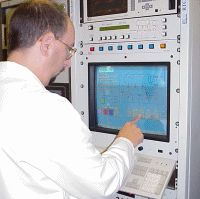
Artisan has been created to reduce the impact of the main variable in vacuum deposition - the operator - by acting as a control interface which is both user and machine-friendly for today's complex vacuum systems and processes. Real-time reaction to process information allows efficient vacuum process management.
Easy to use
Data is presented in an easy-to-read format on a large touchscreen monitor, which also simplifies parameter setting. The PC/PLC-based system has many advantages over predecessor controllers, offering optimal and repeatable processes.
Modular
Future system upgrade is easily accommodated with
Artisan
Customisable
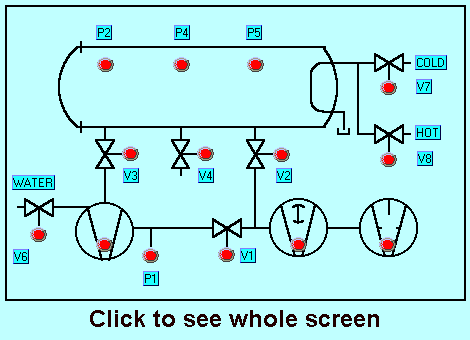
Data can be presented in any way you choose, thermometer-style, bar, or dial gauges to show the full range of vacuum and process parameters - pressure, temperature, voltage, current, water flow, deposition rates etc. Simulated LEDs are also available to indicate the system status.
Trend analysis of vacuum/process parameters is possible in real-time.
Vacuum/process settings are achieved through the touchscreen system. This is done using a virtual rotary knob or slider control.
OEM Sub-System Integration
Industry-standard
Satis RTC listens to its customers and designs to your needs.
Every deposition system is different as are customer requirements. The modular nature of
Artisan
and associated systems enable Satis RTC to cater for any pumping and deposition system configuration.
The power behind our controller lies in the interface - the exchange point between operator and machine. Both need information to run efficiently. For the operator this is presented in a user-friendly manner. The familiar analogue vacuum gauge is reproduced on screen in addition to digital readouts.
Artisan
is not just a stand-alone controller; full integration of OEM sub-systems is achievable. Examples include the Satis RTC VCP-600 Pump Control Station, XCC-101 Quartz Crystal Head Indexer, GIC-100 Gas Inlet Controller, Inficon IC/5, RGA modules, deposition sources, optical monitors and ion/plasma sources.
Artisan
runs under industry-standard operating systems. Remote access via a modem is built-in with future PC/PLC technology upgrade compatibility.




Satis RTC Photonics Systems has developed a compact retrofitable high-energy plasma source for use in conjunction with thermal or electron-beam evaporation.
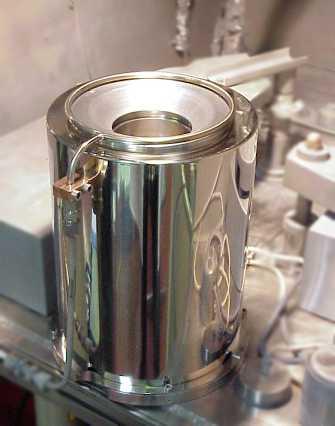
The Satis RTC Plasma Deposition Source - PDS
- is capable of modifying the growing thin film's microstructure to produce dense, near stoichiometric coatings that are impervious to temperature and humidity variations. The refractive indices achieved are near those of bulk materials.
Unlike ion-assisted processes, PDS enables higher deposition rates with coverage over the entire workholder.
PDS is a flexible and powerful system ideal for retrofitting into existing coating systems or installing in new equipment. Its operation can be integrated into process controllers, such as Artisan, for automatic thin film deposition control.

Satis RTC Photonics Systems has the unique capability to accurately determine thickness on rapidly rotating substrates; allowing a tolerance of ±0.2nm for a filter centred on 1550nm to be achieved.
Simple fibre-optic connections to vacuum system ensure straightforward installation. The small physical size of the feedthrough and the non-intrusive design of the probe means that the performance of the deposition system is not compromised in any way by the accommodation of bulky optical components within the process vessel.
The optical module - which contains the source, modulator, reference detector and signal detector - incorporates state of the art design principles to provide exceptional levels of optical noise immunity. This is achieved by the use of a high modulation frequency (typically 200kHz) and a rejection level of 160dB per decade provides complete isolation from optical noise generated by the deposition process.
Additionally, the detected signal level is normalized by reference to a second detector at the source. This gives the user many of the benefits of double beam photometry, including the ability to utilize low signal levels without any perceptible loss in sensitivity or linearity.
The tuneable diode source is now tuned into the specific requirement for the filters with the quarter wave design monitored at the wavelength of use. This monitoring regime provides the self-compensating benefits of turning-point termination.
However, with turning point termination the main problem to be overcome is phase lag of the filters. This can be overcome by playing off the characteristics of one type of digital filter against another to get a defined crossing point which matches with the turning point in the raw data stream.
A dll is added to the software so that the end user can further develop the termination criteria. Non-linear digital filters that have no phase delay and have a predictive capability are in place.
It is not necessary for the user to adjust gains and offsets; just let the monitor experience the maximum and minimum signal levels that are likely to occur during a particular phase of the deposition. It will then automatically set up the measurement parameters to take full advantage of scale expansion.
The monitor can be fitted with a sample and hold option which deals with the problem of measurements being taken from rotating substrates. With the tuneable laser, the full view time through the substrate is 3ms with a beam diameter of 7mm.
The monitor is fitted with an RS232 communications interface. Satis utilise this as all the functions of the monitor - including remote setting of amplification parameters and utilization of the automatic gain setting facility - are available through the RS232.
Electronic interfacing of the monitor to the rest of the system is via RS232 with control and parameter setting via the artisan touchscreen.
The design features of the Satis RTC system include:

The Satis RTC Photonics Systems Evaporant Plume Management System gives superior coating thickness uniformity by controlling the spatial profile of the evaporant plume. Source parameters are adjusted in real-time from data obtained from a distributed quartz crystal measurement system and an optical monitor.

Contact details:
Satis RTC Photonics Systems
Turnpike Farm
Potton Road
Biggleswade
Bedfordshire
SG18 0EP
England
Tel. + 44 (0)1767 313067
Fax.+ 44 (0)1767 600331
Eml. sales@satisrtc.com
This page last updated on November 23rd. 2000 and is © Satis RTC Photonics Systems Y2000